The open-source AI operator for one-person companies
BUILD A
MILLION-DOLLAR
COMPANY. ALONE.
Kaiday is the AI workspace for financial research teams. Describe the study or workflow you need and Kai helps build the evidence, analysis, review tools, documents, and audit trail.
The asymmetry
THEIR DATA IS IN 47 TOOLS.
YOURS IS IN ONE.


- A high price for every integration
- Months of implementation
- Your data locked in each silo
- 47 tools that don't talk to each other
- A 14-month integration
- One price, everything included
- Works from day one
- All your data in one place
- One workspace. Connected by default.
- Instant integration
spend three weeks getting a churn report through five approvals,
ask Kai at 4pm and post the chart in #revenue by 5.
The data moat
Three layers. Every layer makes you harder to copy.
Workspace Data
Every email, document, meeting note, and CRM record lives in one connected graph, not 47 silos.
Workflow Traces
Every automation, every decision path, every client interaction is captured as a traceable workflow.
MiniApp Traces
Every MiniApp generates usage data, user behavior, and operational patterns, compounding intelligence.
The longer you use Kaiday, the smarter it gets. That's the moat.
Messaging
Team chat, with no other app open.
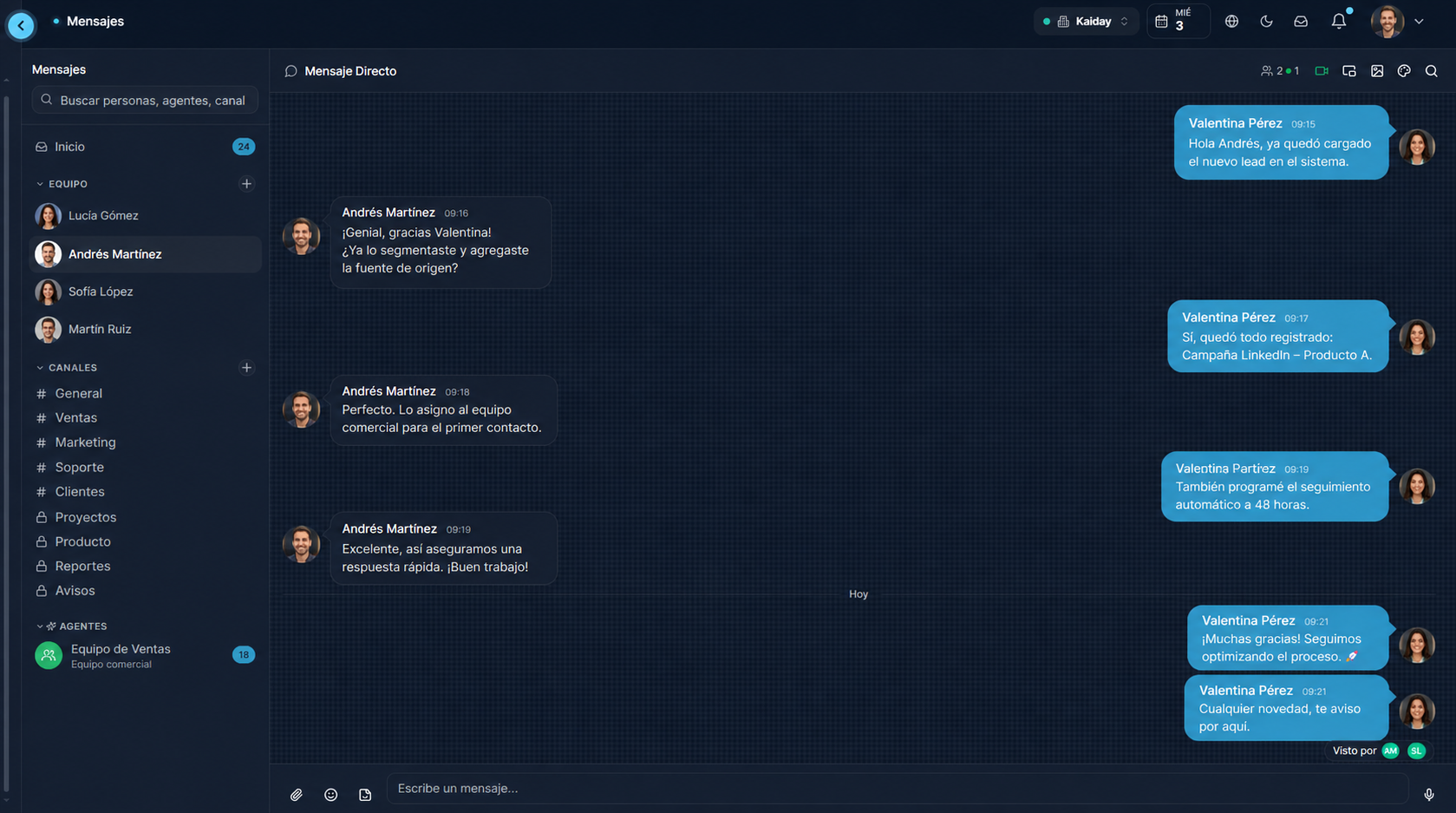
Coordinate with your team and clients in channels and direct messages inside Kaiday. Kai replies in the same thread, so nothing gets lost in another tool.
Meeting recordings
Meet on Google Meet, keep the notes in Kaiday.
Add a Google Meet link to a calendar event. Use the Kaiday Chrome extension to record the meeting, then review its transcript and summary in Kaiday.
- Record a Google Meet with the Chrome extension
- Transcribe the audio in Kaiday
- Review notes and next steps
What it is
ONE WORKSPACE. ONE ASSISTANT.
EVERYTHING YOU NEED.
Kaiday brings email, calendar, messaging, documents, presentations, apps, and automations into one workspace. Record Google Meet audio with the Chrome extension and review it here.
The unfair advantage
YOUR CLIENTS GET
CUSTOM SOFTWARE.
YOU JUST TALK.
Apps are hosted financial workflow tools on your domain, built by Kai from a sentence: hypothesis intake, evidence libraries, valuation calculators, risk trackers, and review dashboards.
You say to Kai
"Build a study review dashboard with benchmark, temporal split, sensitivity results, and limitations."
Live at research.example.com/review
Hosted on your domain. Wired to your studies, evidence, and storage. Iterate by talking: "add transaction-cost assumptions" or "show the temporal holdout beside the full sample."
BUILD THE FINANCIAL WORKFLOW YOU ACTUALLY NEED.
Quant researchers
Hypothesis intake, evidence library, study pipeline, backtest review.
Portfolio managers
Mandate intake, exposure dashboard, risk assessment, committee review.
Risk analysts
Control assessment, exception tracker, model documentation, approval queue.
Investment analysts
Valuation calculator, diligence portal, investment memo, scenario dashboard.
Research leads
Request triage, evidence standards, correction queue, team review status.
Real-estate analysts
Investment affordability model, property comparison, assumptions, review notes.
MiniApps are limited to financial research, risk, portfolio, diligence, and investment-analysis workflows.
The structural moat
MINIAPPS: FULL-STACK APPS
FROM PLAIN LANGUAGE.
WIRED TO YOUR LIVE DATA.
Kaiday generates operational financial research apps, not prototypes or UI mockups. Describe the analytical or review workflow and Kai builds, deploys, and hosts it on your domain.
Plain language to production
Describe an app in a sentence. Kai builds it, deploys it, hosts it under your domain. No code, no config, no DevOps.
Connected to live data
Every MiniApp can read approved studies, evidence, portfolio context, and namespaced app storage. It cannot process payments or execute trades.
Iterated by conversation
"Add an approval step." "Change the grid to 4 columns." Kai edits and redeploys instantly. Your app evolves at the speed of chat.
Why this is a moat
Cursor, v0, Lovable, and Bolt.new generate UI code. Kaiday generates operational software that knows your business.
AI coding tools produce static frontends from prompts. They do not know your studies, evidence standards, portfolio context, or review history. Kaiday MiniApps are full-stack, data-connected, and research-aware.
Your code, inside Kai
CONNECT YOUR REPO.
KAI EDITS IT WITH YOU.
STRAIGHT TO A PULL REQUEST.
Link GitHub, GitLab, or Bitbucket once. Kai reads your whole codebase, understands it, and edits it in plain language, fixes, refactors, new features, then opens a pull request you review and merge.
Connect a repository


3 repos · 12.4k LOC indexed
Edit
Describe a change in one sentence. Kai writes the code across files and shows you the diff before anything ships.
Analyze
Ask about any part of the codebase. Kai traces the logic, explains it, finds bugs, and audits dependencies.
Open a PR
Approve and Kai opens a pull request on your branch, commit message, description, and tests included.
Connected, not exposed
Your code never trains anyone else’s model.
Repos connect through a scoped, revocable token and are read on demand, never copied into shared training data. Your IP stays yours; Kai just works inside it.
What you can actually do now
SOLO, WITH THE LEVERAGE
OF FIFTY.
The specific capabilities you didn't have access to a year ago. Each one is something a small team used to be required for.
Speed
Financial workflow to live App in an afternoon. Reviewer defect to merged PR in minutes.
Polish
One person looks like a company. Your domain, your apps, your branded recordings.
Memory
Never lose an evidence link, reviewer objection, assumption, or decision. Kai connects them across every surface.
Connected operations
Run email, documents, apps, meetings, and automations in one connected workspace.
Pattern recognition
See what a 20-person team would see. Patterns Kai surfaces because it sees everything you've done.
The night shift
While you sleep, Kai works. Inbound email gets triaged and recurring reports run. You wake up with a clear view.
Bespoke per-workflow
Each research workflow gets the data, evidence, controls, and review state it needs without becoming a payment or execution surface.
Compounding context
Day 1 Kai is a tool. Day 180 it knows your evidence standards, assumptions, review history, and decisions.
ON DAY 180, IT'S A DIFFERENT PRODUCT.
Every conversation refines what Kai knows. Every App is one more thing your competitors don't have. Every automation is one more thing you don't touch. After 18 months, a copycat starting today has 18 months of catching up to do.
Memory compounds
Every conversation refines what Kai knows about your business, your clients, your voice.
Apps compound
Each App you build is one more piece of software your competitors using generic SaaS don't have.
Automations compound
Every workflow you describe is one more thing that runs without you.
Data compounds
Documents, messages, and meeting transcripts are linked and searchable.
The promise
FROM ZERO TO RUNNING
IN 30 MINUTES.
A real timeline. By minute 30 you have a verified domain, working email, a financial review app, and an automation routing research decisions.
Sign up. Tell Kai about your business.
One conversation. Kai stores everything in memory and uses it everywhere from here on.
Verify your domain. Mint mailboxes.
Paste the DNS records. While they propagate, you keep moving.
Build your first App.
"Build a backtest review dashboard at research.example.com." Kai writes it, deploys it, and hosts it under your domain.
Wire the automation.
"When a study enters review, notify the assigned reviewer, attach the limitations, and escalate after seven days." Kai turns the sentence into a real workflow.
Schedule the research digest.
"Every Friday, summarize completed studies, open limitations, and pending decisions for #research." Done.
The reasons
EVERY REASON YOU
DIDN'T START. GONE.
Every solo professional has the same mental list of reasons they haven't started the side business, the second company, the productized service. Most of those reasons were real until last year. None of them are real anymore on Kaiday.
“I don't know how to code.”
Kai is the developer. You describe; it ships.
“I can't afford to hire anyone.”
Kai is the team. Marketing, ops, support, dev, one assistant.
“Marketing is overwhelming.”
Kai drafts emails and campaigns. You approve and send.
“My brand looks too small to trust.”
Your own domain, your own apps. You look like a 50-person company.
“My inbox would bury me.”
Kai handles routine threads and flags only what needs you.
“I don't have time alongside my day job.”
Kai works the night shift. You decide in 15-minute windows.
“I don't know where to start.”
Ask Kai. 'What should I build first?', it's already paying attention.
“If everyone uses AI, my edge disappears.”
Your context is yours. Copycats start at zero. You compound.
You can keep waiting for permission.
Or you can describe what you want to Kai and start.
Open source
Your business, your server,
your data.
Kaiday Community is open source. Run the whole platform on your own VPS with one installer — your data stays on your hardware, you bring your own AI and email keys, and nothing locks you in.
$git clone https://github.com/sophometrics/kaiday_community.git$cd kaiday_community && ./install.sh✓ Kaiday is running on your VPSInstall on your own VPS
Clone the repo, run the installer, and Docker Compose brings up the app, databases, and AI services. A small VPS is enough to start.
Bring your own email
Connect any SMTP provider — Mailgun, SendGrid, Postmark, Amazon SES — or the bundled Postfix relay. Point five settings at your provider, publish the DNS records the app shows you, done.
AI inside your inbox
Kai reads, triages, and drafts replies on your own domain, turns research emails into tasks and review decisions, and automations can send mail for you — all on infrastructure you control.
Found a bug or want a feature? Issues and pull requests are welcome — Kaiday is built in the open.
FREQUENTLY ASKED QUESTIONS
Ecosystem
A network of platforms that connect
Kaiday is the hub. Discover the platforms that plug into it and build a fully connected system for your business.
Kaiday
AI workspace
Unifies clients, projects, documents and communication with an assistant that executes tasks, not just answers.
Mobius
Production & administration
The operating system for your plant: production, inventory, purchasing, sales and reports in one place.
HereAI
Retail intelligence
Connect product, inventory, and commercial data for retail and ecommerce analysis.
Agroland
Agronomic intelligence
Agronomic reasoning for growers: monitor your crops and understand what affects them.
YOUR SIDE BUSINESS
STARTS TODAY.
30 minutes from now you have a domain, an inbox, a client-facing app, and an assistant that runs the rest.